 |
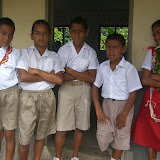
| SEE exam celebrations |
Monday, October 25, 2010

Thursday, October 21, 2010
Pigs and Party Favors: A Tongan Funeral
A few weeks ago, a woman who lived in Tongatapu died. Since, somewhere along her family line, someone lived in Ha’ano, she was to be buried in Ha’ano. And so began the story of my first Tongan funeral.
Had the woman, Sela, died in Ha’ano, she would have been buried within 48 hours. Without constant refrigeration, there is no way to preserve the body, so in Ha’ano, they hurry up and get people in the ground. Yet Sela was from Tongatapu, the “mainland,” so the family froze the body, and waited until a good time for the funeral. The secondary school entrance exam was that week, and there wasn’t enough time for proper mourning, so they postponed the funeral until the desired date: October 13.
(A short detour on the refrigeration of the body: A fellow PCV led a lesson on good food preservation practices for her elementary school class. She asked the class, “What do we put in the refrigerator?” She got common answers like fish, butter, ice cream, and then one girl raised her hand. “Grandma,” she suggested.)
Sela’s family and friends escorted the body from Tongatapu to Ha’apai on the Pulupaki, one of the two inter-island ferries in Tonga. The Pulupaki can hold probably 150 passengers and cargo, and it makes its stops in the main town of each island groups.
Except for the morning of October 13. At about 8:30 am, I stood out on my porch looking at the sea. “My, the Pulupaki looks like it’s getting close. That’s weird,” I thought. Turns out, they were bringing Sela’s body and entourage straight to Ha’ano.
Four boats from Ha’ano headed out to meet the Pulupaki just past the reef. The door opened from the Pulupaki, and people jumped from the big boat to the small boat. Eventually they transferred the body too. (I couldn’t see the jumping, but this is standard Pulupaki disembarking practice in the Ha’afeva Group in Ha’apai.)

The boats brought back perhaps 75 mourners and quite a lot of their stuff. The dock was an anthill. Half the people seemed to be preparing the bed of the pickup truck to carry the body from the dock, and the other half of the people seemed to be undoing whatever the first half had done. Eventually the truck was decorated with woven mats, fake flowers, lace, and a large picture of the deceased.
Slowly, the mourners made their way from the dock to the home of the family of the deceased. For the next few hours, I was in school, but I could hear their singing from my house.
School ended at lunchtime for the funeral, and I prepared to go myself. I don’t own a ta’ovala, the woven mats worn for special occasions such as funeral, and there weren’t any spares at my neighbor’s house, so I just wore all black, and headed over to the funeral. There were people everywhere: on the porch at the family’s house, under a tent outside the house, under the mango tree, under the fekika tree, under the food tent, and scattered along the road. I sat with some youth girls, waiting to see what would happen next.
The group of people under the tent at the house was singing songs the whole time. Apparently, sometimes, the funeral lasts all night, and this group keeps a vigil for over 12 hours.
There was a group packed around tables under another tent. This was the eating tent. In a Tongan funeral, the hosts are expected to feed everyone who attends. At this funeral, there were perhaps 150 adults and another 50+ kids, and about 50 of those people were crammed under that eating tent. They looked ravenous, and when the family started bringing out the food, they gobbled it up as if they’ve never eaten before.
The first wave of people ate, then they vacated their seats and a new group swooped in. I was crushed between the town officer and a friend, and the hosts passed out plastic baggies with manioke (cassava), hot dogs, chicken, and a hard-boiled egg. Soon they came around with a sugary-water drink. And after about 10 minutes, we all left, and the seats filled again.
It was time to process to the church. The body was carried out from the house and reloaded into the back of the truck. A long woven mat stretched from the truck out the back, and mourners followed, carrying the mat.
The church was fuller than I’ve ever seen. The bench I was sitting on actually broke from the number of people, but it didn’t break so much that we couldn’t still sit there. There was the usual singing, standing, sitting, praying, weeping as regular church, but this time there was a body in front of us.
After the service, the truck and followers processed to the cemetery. The Tongan cemetery is a small clearing with body-sized lumps of rocks often decorated with fake flowers and blankets. There were tapa cloths and woven mats decorating today’s gravesite. After more crying, singing, and praying, the pallbearers prepared to lower the body into the ground. They took off all the mats and lace from the box, and at this unveiling of the casket, I heard one woman say, “Oh, look, they have a coffin!” A friend told me that often they just put the body in the ground. Then, the pallbearers lowered the body into a shallow hole, all the men picked up shovels or wood, and they covered the box.
The group left the cemetery, climbing over the brambles and rocks to get back to the road. Then they all turned back to the area where we had eaten, sat down, and waited. Pauline said we were waiting to see what they were going to give. Give? To whom? The church? Oh, well, just go with the flow, Pele, and sit there with the Tongans.
After waiting about an hour, men started dragging out large coconut fronds and arranging them in a large circle on the grassy area. Soon, three men carried out an enormous pig on one of these coconut fronds. (These fronds are pretty impressive; the men were holding up a 150+ lbs pig with just the plant!) They arranged it neatly in the center of the circle.
Then they brought out the kumete – the kava bowl. All the most important men in the community – ministers, the town and district officers, and the noble – arranged themselves in the circle. The tou’a and her two assistants sat down opposite the noble. The husband of the deceased called out the actions. First, he called out thanks to people who gave the pig, and those seated around the circle responded. He called the son of the deceased (who is his own son), and the youth came and touched the pig and kava root sitting at the center of the circle.
Then the son sat down in the middle of the circle, and two men joined him. The two new men proceeded to butcher the pig to pass it out to those at the kava circle. With the first swift slice of the pig, I heard several people in the audience say, “My, that’s a sharp machete!” The continued hacking it up, then the son distributed the pieces. First, the huge torso piece to the noble. Then, the head to the husband. Then smaller chunks for everyone else. After everyone in the circle had received their pig bit, there were some more thank yous, and a member of the families came to remove the pieces of pork before drinking kava.
Since this is far more formal kava than I usually go to (I’ve only seen this kava once before, but it was a mock ceremony; the Peace Corps put it on for us the first day we arrived in Tonga), most of this was new to me. The tou’a used pieces of what looks like raffia to “strain” the kava into a coconut-shell cup. Then, one of her assistants carried the cup to the noble who drank, and the assistant carried the cup back to the tou’a to be refilled and continued around the circle.
After the kava ceremony, the time came for what all the guests were waiting for. They clustered around the back of the truck that was carrying gifts for all the attendees: a bag of frozen chicken and $10 pa’anga. It was the first funeral I’ve been to with party favors.
I asked a couple of Tongan friends why the family passed out cash. Apparently it’s a new practice done by families that feel like they didn’t give enough during the funeral. Maybe this family thought they needed to give more to the guests since they didn’t kill a horse or cow.
Here was yet another example of Tongans keeping up with the Joneses to the point of debt: there were about 200 people at the ceremony. Each got $10 pa’anga and a bag of chicken worth about $4. For those guests, the non-ministers, the family spent about $2800 pa’anga just on the gifts. For the 20 ministers, they each got $20 pa’anga, so that’s another $400 pa’anga. And that’s not considering how much the family spent on the food, transportation from Tonga, casket, and so on. And next Misinale, the church donating event, the family of a deceased is expected to donate several thousand extra pa’anga.
The funeral finally finished after the bedlam of distributing gifts. It was about 6:00 pm. The funeral lasted about 8 hours, soon after the arrival of the body on the boat. Some funerals last all through the night, with singers singing at the house in shifts. For me, the 6 hours I spent in mourning were quite sufficient. I had things to do that day besides wait around for the next phase of mourning. These funerals seem to take up so much of everyone’s time. With all this work that goes into dying, how does anyone have time to live?
Had the woman, Sela, died in Ha’ano, she would have been buried within 48 hours. Without constant refrigeration, there is no way to preserve the body, so in Ha’ano, they hurry up and get people in the ground. Yet Sela was from Tongatapu, the “mainland,” so the family froze the body, and waited until a good time for the funeral. The secondary school entrance exam was that week, and there wasn’t enough time for proper mourning, so they postponed the funeral until the desired date: October 13.
(A short detour on the refrigeration of the body: A fellow PCV led a lesson on good food preservation practices for her elementary school class. She asked the class, “What do we put in the refrigerator?” She got common answers like fish, butter, ice cream, and then one girl raised her hand. “Grandma,” she suggested.)
Sela’s family and friends escorted the body from Tongatapu to Ha’apai on the Pulupaki, one of the two inter-island ferries in Tonga. The Pulupaki can hold probably 150 passengers and cargo, and it makes its stops in the main town of each island groups.
Except for the morning of October 13. At about 8:30 am, I stood out on my porch looking at the sea. “My, the Pulupaki looks like it’s getting close. That’s weird,” I thought. Turns out, they were bringing Sela’s body and entourage straight to Ha’ano.
Four boats from Ha’ano headed out to meet the Pulupaki just past the reef. The door opened from the Pulupaki, and people jumped from the big boat to the small boat. Eventually they transferred the body too. (I couldn’t see the jumping, but this is standard Pulupaki disembarking practice in the Ha’afeva Group in Ha’apai.)

The boats brought back perhaps 75 mourners and quite a lot of their stuff. The dock was an anthill. Half the people seemed to be preparing the bed of the pickup truck to carry the body from the dock, and the other half of the people seemed to be undoing whatever the first half had done. Eventually the truck was decorated with woven mats, fake flowers, lace, and a large picture of the deceased.
Slowly, the mourners made their way from the dock to the home of the family of the deceased. For the next few hours, I was in school, but I could hear their singing from my house.
School ended at lunchtime for the funeral, and I prepared to go myself. I don’t own a ta’ovala, the woven mats worn for special occasions such as funeral, and there weren’t any spares at my neighbor’s house, so I just wore all black, and headed over to the funeral. There were people everywhere: on the porch at the family’s house, under a tent outside the house, under the mango tree, under the fekika tree, under the food tent, and scattered along the road. I sat with some youth girls, waiting to see what would happen next.
The group of people under the tent at the house was singing songs the whole time. Apparently, sometimes, the funeral lasts all night, and this group keeps a vigil for over 12 hours.
There was a group packed around tables under another tent. This was the eating tent. In a Tongan funeral, the hosts are expected to feed everyone who attends. At this funeral, there were perhaps 150 adults and another 50+ kids, and about 50 of those people were crammed under that eating tent. They looked ravenous, and when the family started bringing out the food, they gobbled it up as if they’ve never eaten before.
The first wave of people ate, then they vacated their seats and a new group swooped in. I was crushed between the town officer and a friend, and the hosts passed out plastic baggies with manioke (cassava), hot dogs, chicken, and a hard-boiled egg. Soon they came around with a sugary-water drink. And after about 10 minutes, we all left, and the seats filled again.
It was time to process to the church. The body was carried out from the house and reloaded into the back of the truck. A long woven mat stretched from the truck out the back, and mourners followed, carrying the mat.
The church was fuller than I’ve ever seen. The bench I was sitting on actually broke from the number of people, but it didn’t break so much that we couldn’t still sit there. There was the usual singing, standing, sitting, praying, weeping as regular church, but this time there was a body in front of us.
After the service, the truck and followers processed to the cemetery. The Tongan cemetery is a small clearing with body-sized lumps of rocks often decorated with fake flowers and blankets. There were tapa cloths and woven mats decorating today’s gravesite. After more crying, singing, and praying, the pallbearers prepared to lower the body into the ground. They took off all the mats and lace from the box, and at this unveiling of the casket, I heard one woman say, “Oh, look, they have a coffin!” A friend told me that often they just put the body in the ground. Then, the pallbearers lowered the body into a shallow hole, all the men picked up shovels or wood, and they covered the box.
The group left the cemetery, climbing over the brambles and rocks to get back to the road. Then they all turned back to the area where we had eaten, sat down, and waited. Pauline said we were waiting to see what they were going to give. Give? To whom? The church? Oh, well, just go with the flow, Pele, and sit there with the Tongans.
After waiting about an hour, men started dragging out large coconut fronds and arranging them in a large circle on the grassy area. Soon, three men carried out an enormous pig on one of these coconut fronds. (These fronds are pretty impressive; the men were holding up a 150+ lbs pig with just the plant!) They arranged it neatly in the center of the circle.
Then they brought out the kumete – the kava bowl. All the most important men in the community – ministers, the town and district officers, and the noble – arranged themselves in the circle. The tou’a and her two assistants sat down opposite the noble. The husband of the deceased called out the actions. First, he called out thanks to people who gave the pig, and those seated around the circle responded. He called the son of the deceased (who is his own son), and the youth came and touched the pig and kava root sitting at the center of the circle.
Then the son sat down in the middle of the circle, and two men joined him. The two new men proceeded to butcher the pig to pass it out to those at the kava circle. With the first swift slice of the pig, I heard several people in the audience say, “My, that’s a sharp machete!” The continued hacking it up, then the son distributed the pieces. First, the huge torso piece to the noble. Then, the head to the husband. Then smaller chunks for everyone else. After everyone in the circle had received their pig bit, there were some more thank yous, and a member of the families came to remove the pieces of pork before drinking kava.
Since this is far more formal kava than I usually go to (I’ve only seen this kava once before, but it was a mock ceremony; the Peace Corps put it on for us the first day we arrived in Tonga), most of this was new to me. The tou’a used pieces of what looks like raffia to “strain” the kava into a coconut-shell cup. Then, one of her assistants carried the cup to the noble who drank, and the assistant carried the cup back to the tou’a to be refilled and continued around the circle.
After the kava ceremony, the time came for what all the guests were waiting for. They clustered around the back of the truck that was carrying gifts for all the attendees: a bag of frozen chicken and $10 pa’anga. It was the first funeral I’ve been to with party favors.
I asked a couple of Tongan friends why the family passed out cash. Apparently it’s a new practice done by families that feel like they didn’t give enough during the funeral. Maybe this family thought they needed to give more to the guests since they didn’t kill a horse or cow.
Here was yet another example of Tongans keeping up with the Joneses to the point of debt: there were about 200 people at the ceremony. Each got $10 pa’anga and a bag of chicken worth about $4. For those guests, the non-ministers, the family spent about $2800 pa’anga just on the gifts. For the 20 ministers, they each got $20 pa’anga, so that’s another $400 pa’anga. And that’s not considering how much the family spent on the food, transportation from Tonga, casket, and so on. And next Misinale, the church donating event, the family of a deceased is expected to donate several thousand extra pa’anga.
The funeral finally finished after the bedlam of distributing gifts. It was about 6:00 pm. The funeral lasted about 8 hours, soon after the arrival of the body on the boat. Some funerals last all through the night, with singers singing at the house in shifts. For me, the 6 hours I spent in mourning were quite sufficient. I had things to do that day besides wait around for the next phase of mourning. These funerals seem to take up so much of everyone’s time. With all this work that goes into dying, how does anyone have time to live?
Finding My Way Home
Leaving my island is easy. Coming back is the hard part.
Boats leave almost every weekday to go into town, and usually I can just hop on one of those, ride the boat for about an hour to get to a village where someone has coordinated a truck to pick us up, and arrive in town.
The way back is less straightforward. Recently I had a typical adventure in finding a ride back to Ha’ano.
Monday morning, I woke up at the PCV’s house where I stay in Pangai. By that afternoon, I hoped to be in my own home.
7:30 am: I call a friend in Ha’ano and find that, indeed, a boat has left Ha’ano. I even get the names of people to look for. Mission: Find 2 ministers from Ha’ano or the boat driver.
8:50 am: While riding a bike around town looking for these people who don’t have cell phones, I see the boat driver. He tells me to go to the Church of Tonga’s building so I can ask the ministers what time we’ll leave. His directions and my lacking Tongan leave me clueless as to where the building is, so, after riding around a while looking for it…
9:05 am: I ask for directions. With a semi-clear idea of where the ministers might be, I go to the church. Empty. I go to the nearby building. Empty. I eventually find someone who tells me they are in that nearby building I had just searched.
9:15 am: I find someone who is better informed, and he tells me they are in the church building around the corner.
9:30 am: As I sit outside the church waiting for the meeting to end, a different minister than those I am looking for asks me who I need, and he goes inside to tell the Ha’ano minister to come talk to me.
9:45 am: One of the Ha’ano ministers tells me we’ll be leaving when their meeting ends, maybe 10:00 am. He tells me to take my things to the place where everyone waits for the truck to go to Ha’ano. I hurry back to get everything in order, lest I get left as has happened before.
10:05 am: As I heave my bags down the road, I run into a third minister from Ha’ano carrying a handful of tobacco leaves. We go to a different place than I was told to go to catch the ride. (Had I not seen him, I would have been up a creek, waiting at the wrong place.)
10:10 am: I realize that no one is coordinated and we aren’t nearly about to leave, so I go buy a gas canister.
10:45 am: Now with my gas canister, carried by the boat driver, I return to the group. And we continue to wait.
11:15 am: Eventually a vehicle is arranged to take us the 30 minute ride to the dock.
11:45 am: We leave the dock.
12:40 am: We arrive in Ha’ano.
Boats leave almost every weekday to go into town, and usually I can just hop on one of those, ride the boat for about an hour to get to a village where someone has coordinated a truck to pick us up, and arrive in town.
The way back is less straightforward. Recently I had a typical adventure in finding a ride back to Ha’ano.
Monday morning, I woke up at the PCV’s house where I stay in Pangai. By that afternoon, I hoped to be in my own home.
7:30 am: I call a friend in Ha’ano and find that, indeed, a boat has left Ha’ano. I even get the names of people to look for. Mission: Find 2 ministers from Ha’ano or the boat driver.
8:50 am: While riding a bike around town looking for these people who don’t have cell phones, I see the boat driver. He tells me to go to the Church of Tonga’s building so I can ask the ministers what time we’ll leave. His directions and my lacking Tongan leave me clueless as to where the building is, so, after riding around a while looking for it…
9:05 am: I ask for directions. With a semi-clear idea of where the ministers might be, I go to the church. Empty. I go to the nearby building. Empty. I eventually find someone who tells me they are in that nearby building I had just searched.
9:15 am: I find someone who is better informed, and he tells me they are in the church building around the corner.
9:30 am: As I sit outside the church waiting for the meeting to end, a different minister than those I am looking for asks me who I need, and he goes inside to tell the Ha’ano minister to come talk to me.
9:45 am: One of the Ha’ano ministers tells me we’ll be leaving when their meeting ends, maybe 10:00 am. He tells me to take my things to the place where everyone waits for the truck to go to Ha’ano. I hurry back to get everything in order, lest I get left as has happened before.
10:05 am: As I heave my bags down the road, I run into a third minister from Ha’ano carrying a handful of tobacco leaves. We go to a different place than I was told to go to catch the ride. (Had I not seen him, I would have been up a creek, waiting at the wrong place.)
10:10 am: I realize that no one is coordinated and we aren’t nearly about to leave, so I go buy a gas canister.
10:45 am: Now with my gas canister, carried by the boat driver, I return to the group. And we continue to wait.
11:15 am: Eventually a vehicle is arranged to take us the 30 minute ride to the dock.
11:45 am: We leave the dock.
12:40 am: We arrive in Ha’ano.
An English Quiz
Here’s a quick quiz, with questions from real tests, to see where you can go to high school in Tonga.
1. Which is the opposite of drama?
a. Play
b. Game
c. Song
d. Trick
2. The woman bought ______ flour from the store.
a. many
b. a
c. much
d. one
3. The dog _________ under the table.
a. lied down
b. lay down
c. laid down
d. layed down
Even if you can figure an answer from those questions (and others like it), remember that these Tongan students are taking what is basically a fluency test after only three years of English. Though, obviously, the fluency is fluency according to the Tongans who wrote the test.
1. Which is the opposite of drama?
a. Play
b. Game
c. Song
d. Trick
2. The woman bought ______ flour from the store.
a. many
b. a
c. much
d. one
3. The dog _________ under the table.
a. lied down
b. lay down
c. laid down
d. layed down
Even if you can figure an answer from those questions (and others like it), remember that these Tongan students are taking what is basically a fluency test after only three years of English. Though, obviously, the fluency is fluency according to the Tongans who wrote the test.
Sometimes You Want to Go Where Nobody Knows Your Name
Here on my island of 350 Tongans, there isn’t much anonymity for a palangi like me. Correction: there isn’t any anonymity. Back in December, after being on the island only two weeks, fellow-PCV John was in Ha’ano and we took a walk down to the end of the island. Kids who lived on the other end of my island, where I hadn’t been yet, called out to me, “Hi, Pele!” I turned to John and said, “I’m surprised they don’t already know your name too.” Pause. Pause. Then we heard, “Hi, John!”
I don’t think word of my every move travels as fast as back then when I was still a novelty, but people still know far more than I tell them. “You went to the Wesleyan church today?” “What were you doing at Mehi’s house?”
A few weeks ago I went to the little shop in my village. I had used up all my oil, and I wanted to have another bottle on hand, in case I got the urge to do something that required oil. I returned home, oil in hand. About an hour later, a neighbor came over. “Did you buy oil? Can we use some to fry some fish that we (all of us) will eat?” As quickly as it had come, the oil was gone.
In a country the size of Tonga, with only about 110,000 people, there’s hardly anyplace that doesn’t know what everyone else is doing. And they’re especially interested in what the foreigners are doing. A PCV friend who lives in Vava’u on an outer island similar to mine told me how, for about a week, every time he cooked, his neighbors knew. They would smell the food and quickly come over with hopes of being offered some exciting and different palangi food.
My activities are not only well-known on my own island, but also on the main islands in Ha’apai, Lifuka and Foa. People there know less about my day-to-day habits, but they all still know who I am and where I live. The people who work at the bank, the principals and teachers at the high schools, many kids, and people I swear I’d never seen before in my life will ask me how am I, how’s Ha’ano, and am I eating a lot of fish?
The Peace Corps says that one thing that PCVs deal with when they return to America is not being the center of attention all the time. Back in America, who knows if you bought toilet paper today? Who wants to talk about what you ate for all your meals last week? Maybe it will be difficult adjusting to that when the time comes, but sometimes, right now, I’d kind of like to go where nobody knows my name.
I don’t think word of my every move travels as fast as back then when I was still a novelty, but people still know far more than I tell them. “You went to the Wesleyan church today?” “What were you doing at Mehi’s house?”
A few weeks ago I went to the little shop in my village. I had used up all my oil, and I wanted to have another bottle on hand, in case I got the urge to do something that required oil. I returned home, oil in hand. About an hour later, a neighbor came over. “Did you buy oil? Can we use some to fry some fish that we (all of us) will eat?” As quickly as it had come, the oil was gone.
In a country the size of Tonga, with only about 110,000 people, there’s hardly anyplace that doesn’t know what everyone else is doing. And they’re especially interested in what the foreigners are doing. A PCV friend who lives in Vava’u on an outer island similar to mine told me how, for about a week, every time he cooked, his neighbors knew. They would smell the food and quickly come over with hopes of being offered some exciting and different palangi food.
My activities are not only well-known on my own island, but also on the main islands in Ha’apai, Lifuka and Foa. People there know less about my day-to-day habits, but they all still know who I am and where I live. The people who work at the bank, the principals and teachers at the high schools, many kids, and people I swear I’d never seen before in my life will ask me how am I, how’s Ha’ano, and am I eating a lot of fish?
The Peace Corps says that one thing that PCVs deal with when they return to America is not being the center of attention all the time. Back in America, who knows if you bought toilet paper today? Who wants to talk about what you ate for all your meals last week? Maybe it will be difficult adjusting to that when the time comes, but sometimes, right now, I’d kind of like to go where nobody knows my name.
Saturday, September 18, 2010
Packing List (Continued)
A few months ago, I wrote a packing list for new PCVs coming to Tonga.
Now, after spending several nights in the main town of Pangai, I have new additions to the list: ear plugs and eye shades.
Though I have my fair share of ridiculous noises throughout the night (horses, dogs, people yelling at each other), it all pales in comparison to the big "city." In Pangai, there are dogs galore, but also cars, incessant church bells, firetrucks (and they were in action this past week), stereos, not to mention the constant hum of the generator a few blocks away. This all makes getting rest difficult and, after sunrise, just about impossible.
When the churches began their singing at 5:30am, when the baby across the street was screaming at 4:00am, or when the people on my back porch didn't go to bed until 2:00am, I really wish I had those ear plugs. And for the practically daily nap with the sun streaming into my bedroom, I really wish I had those shades too.
Now, after spending several nights in the main town of Pangai, I have new additions to the list: ear plugs and eye shades.
Though I have my fair share of ridiculous noises throughout the night (horses, dogs, people yelling at each other), it all pales in comparison to the big "city." In Pangai, there are dogs galore, but also cars, incessant church bells, firetrucks (and they were in action this past week), stereos, not to mention the constant hum of the generator a few blocks away. This all makes getting rest difficult and, after sunrise, just about impossible.
When the churches began their singing at 5:30am, when the baby across the street was screaming at 4:00am, or when the people on my back porch didn't go to bed until 2:00am, I really wish I had those ear plugs. And for the practically daily nap with the sun streaming into my bedroom, I really wish I had those shades too.
Thursday, September 16, 2010
Through a Parent's Eyes
In July, my parents came to visit me in Tonga for about 10 days. After their return to America, I asked my mom to be a guest blogger to share her point of view on all things Tonga. Here it is:
In early July, Blair’s dad and I spent a week with her on her outer island in the Ha’apai group in the central part of Tonga . She asked me to give my perspective about our visit for her blog. In case you don’t read the whole entry, the final word from here is that is we are so glad we went, not only to see Blair for the first time in nine months, but also to better understand her living circumstances and the culture, to get to know some of the people on her island, and to meet her best Peace Corps friends. At the end of the trip, we both said that despite the remoteness and lack of some comforts to which we’re accustomed, we’d go back in a flash for another visit. If your son or daughter is in the PC there, I’d highly recommend the trip.
Background Information
Missing Blair over the past many months had led me to try to learn as much as possible about what she might be experiencing. During her first six months in Tonga, she experienced two earthquakes, tsunami warnings, and a level five cyclone which caused her to have to evacuate her island. By the end of cyclone season, I felt I deserved at least a certificate in Tongan meteorology.
Over several months of phone calls, we heard her mention Juleigh, John, and Todd often enough that I knew they were special and started following their blogs too. Here’s a link that shows all the Tonga PCVs’ blogs:
http://www.peacecorpsjournals.com/?showcountryinfo,tn
Since Blair doesn’t have internet connectivity on her remote island, she only uploads her blogs when she’s on the island of Lifuka in the town of Pangai . By following her friends’ blogs, I had much more up-to-date info than if I had followed only her blogs. I also felt like I knew her friends before I met them in person (no doubt a little disconcerting for them!).
Setting the Stage
Ken and I spent three and one-half days in NZ before heading to Tonga. While we were in NZ, Blair called us to say that she was in Pangai and had been trying unsuccessfully for a couple of days to return to her island. She was unsuccessful because no boat had fuel, because the captain of the boat that takes fuel from the capital city to the other islands had died in an accident from the fumes of the boat. (At this point in the call, as we were driving through NZ countryside, I was searching for paper and pencil to take notes on what sounded like the final verse of “There Was an Old Lady Who Swallowed a Fly”.) Apparently, since the captain was the only one who is allowed to transport fuel, no fuel was available to operate the boats which run from Lifuka to Blair’s island of Kauvai .
Blair told us that she would continue trying to get home so she could return to work. However, if she found a boat with fuel and if she got home, she might not be able to get back to Pangai to meet us, and we might not be able to get to her island on our own because of the lack of fuel. Having traveled 9,000 miles to see her, I was certain that even if it required paddling a kayak, building a raft, or swimming with sharks... we would get to her!
As it turned out, another captain came to work, and the islands had fuel by the time we arrived. But the possibility that something as essential as fuel might not be available foreshadowed similar occurrences during our visit.
Visiting Pangai
We arrived via an old Convair 440 (a prop airplane kind of like a DC-6), and had to make a fly-by of the airport because, as the pilot reported, “there were pigs on the runway” (really!). Blair, John, and Juleigh met us at the airport wearing full Tongan dress. Blair and Juleigh gave us gorgeous, fragrant leis which they had made! We hitched a ride back into town on the back of a flatbed truck, a great way to see that part of the island.
We stayed at Evaloni’s Guest House. As Blair had told us in advance, “Don’t expect this to be like any guest house you’ve ever seen." She chose it because it’s where the Tongan central office PC staff stays when visiting Ha’apai. If you stay there, ask for one of the two upstairs rooms. We stayed in both upstairs rooms and preferred the one closer to the front of the house. Both rooms have bathrooms with cold water showers. Bring your own soap and towels (wish we’d known that before the first night!). When we arrived at the guest house, we couldn’t find anyone who worked there. Blair wrote a note in Tongan to the owner explaining that we wanted a “suite” for one night. We left our bags under a desk and headed on foot to John’s house.
There, we met Todd, the fourth member of Blair’s close-knit group, and were impressed with the culinary talents he provided in the dinner preparation. John, who has become quite adept at spear fishing, had caught 3-4 good sized fish earlier in the day which he, Juleigh, Blair, and Todd turned into a delicious curried stew. If I hadn’t known better, I’d have thought these four PCVs had been best friends forever. Being foreigners, dropped on two small dots of land, in the middle of the largest ocean on earth, has a way of quickly creating strong bonds. They clearly recognize how fortunate they are to have such a supportive foursome that genuinely enjoys each other’s company. We also thoroughly enjoyed our time with all of them.
Visiting Kauvai
The next day, riding on the bow of a small wooden boat, we traveled 45 minutes to Blair’s island. The seas were calm and just like the ride in the back of the flatbed, it allowed for uninterrupted viewing.
Although Blair will roll her eyes when she reads this because her dad repeated it so often, she really does “have a good set-up” on her island. Her house is quite spacious. She has a kitchen sink with running water and a back porch overlooking the ocean. Looking out on the Pacific, it could have been million dollar ocean front property, but looking inland, the poverty was obvious. Since her house is located on the school grounds, it takes less than a minute to walk to her class. The school grounds are surrounded by a rock wall with a gate near her front door which keeps the pigs out of her area most of the time. Because she’s so close to the ocean, she often gets breezes when others on the island do not. Being on a remote island, there’s no light pollution to interfere with the incredible view of the southern hemisphere’s stars.
The Tongans we met were warm and giving. They genuinely seem to care for Blair (locally known as Pele since the letters B and R do not exist in the Tongan alphabet) and to have accepted her as part of their extended community family. Her students appeared eager to learn, and they hung on her every word. It was easy to understand why Tonga is referred to as “the friendly islands”.
But it’s not paradise. Blair has electricity only between 7pm and 2am. The electricity also went off momentarily every night at 8:30pm, which can be unnerving while showering at night in an outbuilding when the water pipe also breaks and begins flooding the toilet next to your shower. No electricity means no refrigeration, which limits the life of leftovers. The running water is not drinkable. Drinking water is carried by jug or bottle from a cistern located next to the school. We boiled water in an electric pot each night while the electricity was on. For coffee and tea the next morning, some water went directly into a thermos.
As she had told us repeatedly before we arrived, very few things are available for purchase on her island. We didn’t fully appreciate that fact until we started to prepare food, repair her gutters, fix her leaking toilet, fix latches on her outhouse doors, and build some shelves (so Blair could get her clothes/books/papers off the floor). We would have been much more successful with a Safeway and Home Depot down the street. Fortunately, she had a supply of duct tape, which played an important role in all the projects. Her house came with a table, which she uses as a desk, and one useable chair. We sat on the floor on mats or floor pillows we had sent her. She has a kitchen stove fueled by a propane tank which must be refilled on another island and transported by hand in a boat to her island. Her toilet is behind her next door neighbor’s house (her principal lives next door). There were often people sitting right in front of the outhouse doors (which led to the repair work to latch the doors when occupied!).
On our first night at her house, she turned on the fuel to light the stove to cook pasta, but quickly decided that there must be a problem with the connection hose because the smell of gas was too strong. After trying to make some adjustments, the pasta idea was abandoned. She seemed unfazed by the prospect of no dinner (and every other difficulty we encountered). Now we better understand why.
Soon her Tongan friends began arriving. One brought us dinner, while another brought a kiekie (a woven belt with woven strips hanging down from the belt) which her friend had made for me. During our stay, friends and neighbors supplied us with prepared food delicacies as well as fresh fish and coconuts. Three of our meals were eaten with different families, and each time we experienced the warmest welcomes imaginable. The food was good and abundant, whether served in their homes or delivered to Blair’s house. Many also gave us gifts.
We had taken gifts for Blair’s Tongan friends, but we received so much from so many, we felt we should have taken more gifts for them. In reality, there’s no way we could have given as much to them as they gave to us, and as Blair said, they didn’t expect anything from us in return. Gladly sharing whatever they had with others, even if it meant they had nothing left after sharing, was one of the most touching parts of the trip. It’s something on which we’ve reflected many times since returning home. It’s more than taking soup to a sick friend or having a grieving neighbor over for dinner. Although I can’t see giving the last of my food or my possessions to someone else, our brief encounter with a society which actually shares everything as a way of life was quite inspiring.
Our brief Tongan encounter also has made me even more aware of how much of what we send to the land fill would be considered valuable in poor countries. Shortly after returning home, I saw in our neighborhood that people had placed pieces of lumber and shelving out on the curb for the rubbish truck. I kept thinking, “If we had found that much wood on Blair’s island, we could have built so much more furniture.”
Ken and I always knew that Blair was a pretty amazing daughter. But seeing how she has accepted the constraints of the culture and living circumstances, has been accepted by the people, learned the language, learned how to gut and clean a fish, used her creativity and resourcefulness to overcome obstacles, and not the least significantly, learned how to deal with creepy-crawly things that would have sent her into orbit back at home (you have no idea...). We were (and are) so very proud of her.
If you’re a parent of a PCV in Tonga , I hope you get to visit your son or daughter while they are there. If you do, I hope you enjoy it as much as we did. Those who say the young adults of the millennium generation require too much “care and feeding” have not seen the PCVs in Tonga . They are awesome!
In early July, Blair’s dad and I spent a week with her on her outer island in the Ha’apai group in the central part of Tonga . She asked me to give my perspective about our visit for her blog. In case you don’t read the whole entry, the final word from here is that is we are so glad we went, not only to see Blair for the first time in nine months, but also to better understand her living circumstances and the culture, to get to know some of the people on her island, and to meet her best Peace Corps friends. At the end of the trip, we both said that despite the remoteness and lack of some comforts to which we’re accustomed, we’d go back in a flash for another visit. If your son or daughter is in the PC there, I’d highly recommend the trip.
Background Information
Missing Blair over the past many months had led me to try to learn as much as possible about what she might be experiencing. During her first six months in Tonga, she experienced two earthquakes, tsunami warnings, and a level five cyclone which caused her to have to evacuate her island. By the end of cyclone season, I felt I deserved at least a certificate in Tongan meteorology.
Over several months of phone calls, we heard her mention Juleigh, John, and Todd often enough that I knew they were special and started following their blogs too. Here’s a link that shows all the Tonga PCVs’ blogs:
http://www.peacecorpsjournals.com/?showcountryinfo,tn
Since Blair doesn’t have internet connectivity on her remote island, she only uploads her blogs when she’s on the island of Lifuka in the town of Pangai . By following her friends’ blogs, I had much more up-to-date info than if I had followed only her blogs. I also felt like I knew her friends before I met them in person (no doubt a little disconcerting for them!).
Setting the Stage
Ken and I spent three and one-half days in NZ before heading to Tonga. While we were in NZ, Blair called us to say that she was in Pangai and had been trying unsuccessfully for a couple of days to return to her island. She was unsuccessful because no boat had fuel, because the captain of the boat that takes fuel from the capital city to the other islands had died in an accident from the fumes of the boat. (At this point in the call, as we were driving through NZ countryside, I was searching for paper and pencil to take notes on what sounded like the final verse of “There Was an Old Lady Who Swallowed a Fly”.) Apparently, since the captain was the only one who is allowed to transport fuel, no fuel was available to operate the boats which run from Lifuka to Blair’s island of Kauvai .
Blair told us that she would continue trying to get home so she could return to work. However, if she found a boat with fuel and if she got home, she might not be able to get back to Pangai to meet us, and we might not be able to get to her island on our own because of the lack of fuel. Having traveled 9,000 miles to see her, I was certain that even if it required paddling a kayak, building a raft, or swimming with sharks... we would get to her!
As it turned out, another captain came to work, and the islands had fuel by the time we arrived. But the possibility that something as essential as fuel might not be available foreshadowed similar occurrences during our visit.
Visiting Pangai
We arrived via an old Convair 440 (a prop airplane kind of like a DC-6), and had to make a fly-by of the airport because, as the pilot reported, “there were pigs on the runway” (really!). Blair, John, and Juleigh met us at the airport wearing full Tongan dress. Blair and Juleigh gave us gorgeous, fragrant leis which they had made! We hitched a ride back into town on the back of a flatbed truck, a great way to see that part of the island.
We stayed at Evaloni’s Guest House. As Blair had told us in advance, “Don’t expect this to be like any guest house you’ve ever seen." She chose it because it’s where the Tongan central office PC staff stays when visiting Ha’apai. If you stay there, ask for one of the two upstairs rooms. We stayed in both upstairs rooms and preferred the one closer to the front of the house. Both rooms have bathrooms with cold water showers. Bring your own soap and towels (wish we’d known that before the first night!). When we arrived at the guest house, we couldn’t find anyone who worked there. Blair wrote a note in Tongan to the owner explaining that we wanted a “suite” for one night. We left our bags under a desk and headed on foot to John’s house.
There, we met Todd, the fourth member of Blair’s close-knit group, and were impressed with the culinary talents he provided in the dinner preparation. John, who has become quite adept at spear fishing, had caught 3-4 good sized fish earlier in the day which he, Juleigh, Blair, and Todd turned into a delicious curried stew. If I hadn’t known better, I’d have thought these four PCVs had been best friends forever. Being foreigners, dropped on two small dots of land, in the middle of the largest ocean on earth, has a way of quickly creating strong bonds. They clearly recognize how fortunate they are to have such a supportive foursome that genuinely enjoys each other’s company. We also thoroughly enjoyed our time with all of them.
Visiting Kauvai
The next day, riding on the bow of a small wooden boat, we traveled 45 minutes to Blair’s island. The seas were calm and just like the ride in the back of the flatbed, it allowed for uninterrupted viewing.
Although Blair will roll her eyes when she reads this because her dad repeated it so often, she really does “have a good set-up” on her island. Her house is quite spacious. She has a kitchen sink with running water and a back porch overlooking the ocean. Looking out on the Pacific, it could have been million dollar ocean front property, but looking inland, the poverty was obvious. Since her house is located on the school grounds, it takes less than a minute to walk to her class. The school grounds are surrounded by a rock wall with a gate near her front door which keeps the pigs out of her area most of the time. Because she’s so close to the ocean, she often gets breezes when others on the island do not. Being on a remote island, there’s no light pollution to interfere with the incredible view of the southern hemisphere’s stars.
The Tongans we met were warm and giving. They genuinely seem to care for Blair (locally known as Pele since the letters B and R do not exist in the Tongan alphabet) and to have accepted her as part of their extended community family. Her students appeared eager to learn, and they hung on her every word. It was easy to understand why Tonga is referred to as “the friendly islands”.
But it’s not paradise. Blair has electricity only between 7pm and 2am. The electricity also went off momentarily every night at 8:30pm, which can be unnerving while showering at night in an outbuilding when the water pipe also breaks and begins flooding the toilet next to your shower. No electricity means no refrigeration, which limits the life of leftovers. The running water is not drinkable. Drinking water is carried by jug or bottle from a cistern located next to the school. We boiled water in an electric pot each night while the electricity was on. For coffee and tea the next morning, some water went directly into a thermos.
As she had told us repeatedly before we arrived, very few things are available for purchase on her island. We didn’t fully appreciate that fact until we started to prepare food, repair her gutters, fix her leaking toilet, fix latches on her outhouse doors, and build some shelves (so Blair could get her clothes/books/papers off the floor). We would have been much more successful with a Safeway and Home Depot down the street. Fortunately, she had a supply of duct tape, which played an important role in all the projects. Her house came with a table, which she uses as a desk, and one useable chair. We sat on the floor on mats or floor pillows we had sent her. She has a kitchen stove fueled by a propane tank which must be refilled on another island and transported by hand in a boat to her island. Her toilet is behind her next door neighbor’s house (her principal lives next door). There were often people sitting right in front of the outhouse doors (which led to the repair work to latch the doors when occupied!).
On our first night at her house, she turned on the fuel to light the stove to cook pasta, but quickly decided that there must be a problem with the connection hose because the smell of gas was too strong. After trying to make some adjustments, the pasta idea was abandoned. She seemed unfazed by the prospect of no dinner (and every other difficulty we encountered). Now we better understand why.
Soon her Tongan friends began arriving. One brought us dinner, while another brought a kiekie (a woven belt with woven strips hanging down from the belt) which her friend had made for me. During our stay, friends and neighbors supplied us with prepared food delicacies as well as fresh fish and coconuts. Three of our meals were eaten with different families, and each time we experienced the warmest welcomes imaginable. The food was good and abundant, whether served in their homes or delivered to Blair’s house. Many also gave us gifts.
We had taken gifts for Blair’s Tongan friends, but we received so much from so many, we felt we should have taken more gifts for them. In reality, there’s no way we could have given as much to them as they gave to us, and as Blair said, they didn’t expect anything from us in return. Gladly sharing whatever they had with others, even if it meant they had nothing left after sharing, was one of the most touching parts of the trip. It’s something on which we’ve reflected many times since returning home. It’s more than taking soup to a sick friend or having a grieving neighbor over for dinner. Although I can’t see giving the last of my food or my possessions to someone else, our brief encounter with a society which actually shares everything as a way of life was quite inspiring.
Our brief Tongan encounter also has made me even more aware of how much of what we send to the land fill would be considered valuable in poor countries. Shortly after returning home, I saw in our neighborhood that people had placed pieces of lumber and shelving out on the curb for the rubbish truck. I kept thinking, “If we had found that much wood on Blair’s island, we could have built so much more furniture.”
Ken and I always knew that Blair was a pretty amazing daughter. But seeing how she has accepted the constraints of the culture and living circumstances, has been accepted by the people, learned the language, learned how to gut and clean a fish, used her creativity and resourcefulness to overcome obstacles, and not the least significantly, learned how to deal with creepy-crawly things that would have sent her into orbit back at home (you have no idea...). We were (and are) so very proud of her.
If you’re a parent of a PCV in Tonga , I hope you get to visit your son or daughter while they are there. If you do, I hope you enjoy it as much as we did. Those who say the young adults of the millennium generation require too much “care and feeding” have not seen the PCVs in Tonga . They are awesome!
Subscribe to:
Posts (Atom)